Nobody budgets for map maintenance before their first AMR deployment. The capital expense for the robots is visible and gets scrutinized. The integration project has a scope, a timeline, and a line item. But the ongoing cost of keeping the facility map accurate enough to navigate against — that almost never makes it into the initial business case.
After a few months of operations, it starts to show up. Not as a single budget line, but diffusely: in the staff time spent clearing robot stalls, in the reduced robot speeds operators dial in to compensate for unreliable path planning, in the engineering hours that go to map update sessions instead of planned feature work. By the time someone tries to quantify it, the costs are scattered across three departments and nobody owns the number.
This post is about making that cost visible before it surprises you.
The Life of a Facility Map
Initial SLAM mapping is typically done during the deployment integration phase, often on a weekend or during a planned low-activity window. The robot drives every aisle, the SLAM algorithm builds an occupancy grid, the integrator validates it and loads it into the fleet system. At this moment, the map is accurate. Every wall, every fixed shelf unit, every structural column is where the map says it is.
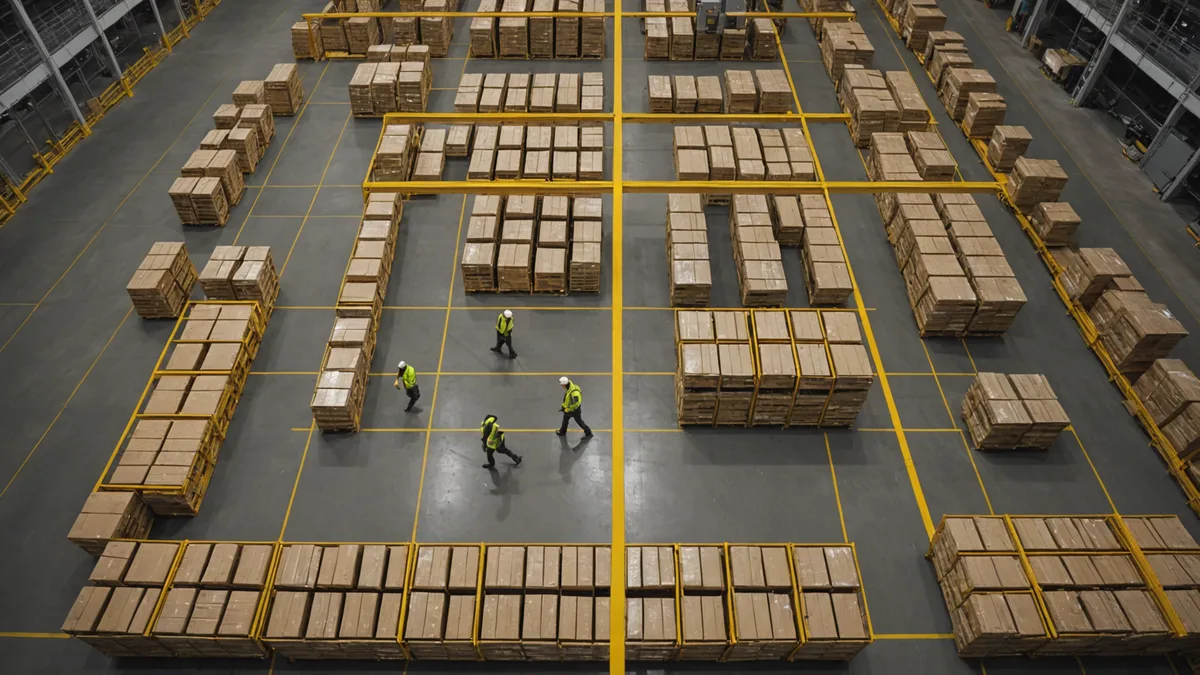
Then operations resume and the facility starts to evolve. A seasonal product flow change moves 200 pallets to a new staging area in zone C. An overflow from receiving creates a temporary pallet stack in aisle 14 that becomes semi-permanent by week three. The receiving dock staging area gets reorganized for a new carrier pattern. A new industrial shelving unit arrives for a promotional inventory run and gets placed without a corresponding map update.
None of these changes are remarkable. They are normal warehouse operations. The problem is that each one creates a delta between map and reality, and those deltas compound. The map starts as a 100% accurate representation of the facility. After six months of normal operations without rigorous map maintenance, that accuracy is somewhere in the 75 to 85% range for a typical ambient fulfillment environment — meaning 15 to 25% of the facility has features that differ meaningfully from what the robot's map shows.
What Map Debt Costs in Practice
Map debt manifests in three operational cost categories:
Direct stall incidents. A robot encounters an obstacle that should not be there according to its map — or the reverse, plans a path through a space the map shows as clear but is no longer navigable. In both cases, the robot stalls or enters a recovery behavior cycle. A typical stall in an active picking environment requires a staff member to physically clear the robot, acknowledge the fault, and restart the mission. Depending on the facility layout and staff positioning, this costs 3 to 8 minutes of labor per incident. Multiply by incident frequency: in a facility with significant map debt, stall rates of 4 to 8 per robot per shift are not unusual.
Conservative speed and route profiles. Operations teams learn quickly which zones are unreliable. The pragmatic response is to reduce robot speed limits in those zones and add wider safety margins. A robot running at 0.8 m/s in a zone where it could safely run at 1.2 m/s is completing 33% fewer pick cycles per hour in that zone. If 30% of the facility is in a "slow down and be careful" regime, the fleet's effective throughput is measurably below its rated capacity — and that gap never gets attributed to map maintenance debt in the performance reports.
Engineering time for map updates. When the operations team finally escalates a stall cluster to the engineering team, the typical resolution is a partial map update. The process: take one robot offline, run a new SLAM mapping pass in the affected zone, validate the resulting map segment against the known facility state, merge it into the fleet map file, validate the merged map for consistency, push to all robots, and monitor the first few missions in the updated zone. In our experience, a single zone update takes 2 to 4 hours of skilled engineering time. Do this twice a month across three to four zones and you have 12 to 32 engineering hours per month on map maintenance — time that is not going to product improvement or new integrations.
Why the Cost Is Invisible at Deployment Time
The initial deployment ROI calculation typically models robot throughput based on design capacity, headcount reduction from automation, and error rate improvements. It does not model the ongoing operational overhead because at deployment time, the map is accurate. The pilot went fine. The facility was staged for the demo. Nobody has reason to model a degradation curve.
The degradation curve is real and fairly predictable once you have seen it a few times. The rate of map decay depends primarily on how frequently the facility layout changes and how rigorously operations enforces "put everything back exactly where it was." In highly disciplined lean operations with fixed storage locations and rigorous 5S discipline, map decay is slow. In environments with high product velocity, seasonal reconfigurations, and ad hoc overflow staging — which describes most mid-sized fulfillment centers — map decay is significant within 60 to 90 days of deployment.
The Three Strategies Operators Actually Use
We have seen three distinct approaches to managing map debt, each with different cost structures:
Reactive map maintenance: Update the map when stall rates spike. This is the most common approach and the most expensive long-term because stall spikes happen during peak periods, when staff time is most constrained and when the cost of disruption is highest. It also means the facility is running on a degraded map for extended periods between updates.
Scheduled map maintenance: Dedicate one robot per month to a full facility re-mapping pass during low-traffic hours. More predictable but still requires engineering time for validation and deployment, and monthly cadence may still be insufficient for high-change environments. The advantage is that it turns map maintenance into a planned activity with a known cost, rather than an unplanned emergency.
Reducing map sensitivity: Run the robot perception stack in a mode that is more tolerant of map delta — relying more heavily on real-time sensor data and less on static map constraints. This is the direction we took with Mobvynt. Rather than making map maintenance more rigorous (which is operationally hard to sustain), we designed the navigation stack to be less dependent on the static map being current. The robot still uses its base occupancy map for localization and for representing features that genuinely do not change. But its path planning and obstacle avoidance operates against the live sensor data, meaning a pallet that moved last Tuesday is navigated around correctly even if the map was last updated three months ago.
What This Changes About the ROI Calculation
We are not saying map maintenance becomes zero with a better perception stack. Localization depends on the base map being approximately correct; a facility that has been fully reorganized since the last mapping session will see localization degradation. Major layout changes still need a map update.
What changes is the frequency and urgency. Map updates become a quarterly or semi-annual scheduled event — aligned with major seasonal reconfigurations — rather than a monthly reactive necessity. The engineering overhead goes from 12 to 32 hours per month to 4 to 8 hours per quarter. And the stall incidents that were driving reactive updates in the first place drop significantly because the robot is no longer relying on the map to tell it whether the path ahead is clear.
That shift is worth modeling explicitly before deployment. The map maintenance overhead that most AMR operators eventually discover is a real cost that should be in the business case — not as a reason to avoid automation, but as a reason to choose a navigation architecture that does not compound that cost over time.